
Coaching is a process of guiding, supporting, and empowering individuals to achieve their personal, academic, or professional goals. It involves a collaborative relationship between the coach and the individual, where the coach helps identify strengths, challenges, and opportunities for growth.
Jenny Rogers is one of the UK’s most experienced executive coaches with 30 years of successful practice. She won the Henley Business School Award in 2019 for Outstanding Contribution to Coaching. Her clients include Chief Executives and Directors of some of the UK’s best-known organisations. As well as running her own practice, Jenny has trained and supervised many hundreds of coaches.
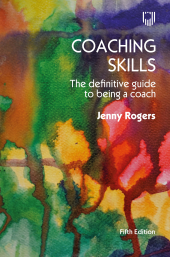
Coaching Skills: The Definitive Guide to being a Coach, 5th Edition
Coaching Skills is still as important as it was when it was first written twenty years ago and remains the authoritative text for both trainee and practising coaches. Now in its 5th edition, the book has been substantially updated throughout while still retaining Jenny Rogers’ unique voice, drawing upon her wealth of experience and expertise.
Practicalities and theory are both expertly covered in the 5th edition through case studies and professional guidance, with emphasis on psychological awareness and understanding.
This new edition includes:
- New chapters on trauma and relationships
- A new chapter on identity and inclusion
- Substantial updates to reflect changes in technology and the coaching market
With updated case studies and examples, this book will support you whether you are an experienced coach or a beginner taking your first steps on the journey to becoming a master practitioner. Coaching Skills gives real-life answers to the challenging questions that coaches face as they develop their coaching practice.
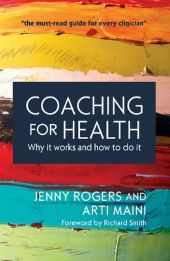
Coaching for Health: Why it works and how to do it, 1st Edition
This book has a radical new message for any clinician: through coaching you reduce your own stress and you get far better outcomes for patients. ‘Coaching for health’ means creating a different relationship in consultations, asking a different kind of question and giving information in a different way. It goes beyond what is usually meant by ‘patient-centred practice’. It will work with virtually any patient. When you take a coaching approach the chances are that your patients gain confidence in managing their own health, reduce the number of appointments they request, are less likely to need emergency admissions and are more likely to take their medication.
Coaching is not just a technique that you switch on and off, it is a wholly different mindset. Coaching for Health explains the rationale for a coaching approach and gives pragmatic step by step help on how to do it.
The authors - one an executive coach, one a doctor - write from their extensive, collective experience. Having trained many hundreds of clinicians in coaching skills, Jenny Rogers and Arti Maini have seen first hand how transforming it can be to use in practice.
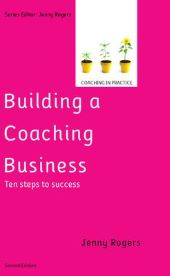
Building a Coaching Business: Ten steps to success, 2nd Edition
This practical guide is for anyone contemplating coaching as a career: coaches in training, coaches already trained and hoping to build a thriving business. This totally revised second edition offers step by step guidance on what to do:
- What does it take to succeed as a coach? How long does it take?
- Why it matters to get practice clients and where to find them
- Why is it so important to think like a buyer rather than like a seller?
- What can you charge?
- How do you make yourself distinctive in a crowded market?
- What do you need to do to attract clients? Which marketing materials and methods pay off and which are a waste of time?
- How can you exploit social media?
- Overcoming your fear of selling: how to sell with integrity
- Going for growth: what is involved in building an even bigger business?
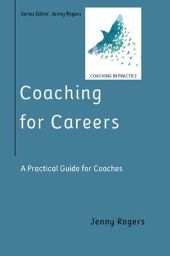
Coaching for Careers: A Practical Guide for Coaches, 1st Edition
How can coaches help clients navigate the changing world of work? This book offers a step-by-step, practical guide to running a complete career coaching programme: assessing the present; looking at motivation, skills and ‘personal brand’; writing the most powerful CV/résumé; getting through a job interview or assessment centre successfully; and negotiating terms for a new job. Career coaching has never been needed more now that jobs for life have disappeared, being made redundant is common, the ‘gig economy’ is here to stay, and young people often must start in unpaid roles.
The principles of career coaching are much the same whether you are a professional executive coach or a volunteer working for a charity whose aim is to get people back into work. But how do you do it most effectively? The focus must be on the whole career coaching cycle and building a holistic understanding of how a client’s personal and professional life has influenced the person they are today, who they want to be, and how to set successful goals.
Important reading for any coach who wants to understand and improve their career coaching.
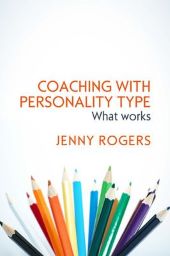
Coaching with Personality Type: What Works, 1st Edition
Most coaches know that Personality Type indicators can add enormous value to their work. Based on the work of the distinguished Swiss psychologist, Carl Jung, questionnaires such as the MBTI® and its many rivals can give clients swift, deep, unsettling and reliable insights into their own behaviour and needs. Yet many coaches hesitate, asking questions such as:
- Do I know enough about it to use it confidently?
- Where does it add value in work with senior leaders?
- Where can it be useful when I’m working with a client on career issues?
- What should I do when a client challenges me on validity and reliability?
- What other psychometric assessments might I use and how do they complement Type indicators?
- How should I use it with groups, for instance on management development programmes?
- How does it work as part of a team coaching project?
This book will build your confidence. It gives you honest, straightforward, practical and realistic advice on these and other issues, from an author who is internationally recognised as a leading thinker and practitioner in executive and team coaching, as well as being an expert on Jungian Type. The book is enriched by dozens of short case studies.
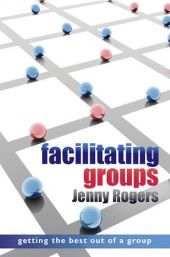
Facilitating Groups, 1st Edition
Every manager, every coach, every HR professional, every trainer, every team leader - anyone who needs to get the best out of a group needs to know how to facilitate. So what is facilitation and why is it so important?
To facilitate means to make something easy, so the challenge of facilitation is to make it easier for a group to learn, to develop and succeed. Facilitation bypasses coercion, teaching or chairing. It's about how to read a group, how to challenge group members appropriately and how to name the apparently unnameable. It's about being able to design events which perfectly match what the group needs and then to run such events with aplomb.
Facilitating Groups, in this new edition, is written by a facilitator with thirty years of experience and cuts to the heart of the practical skills that any facilitator needs.
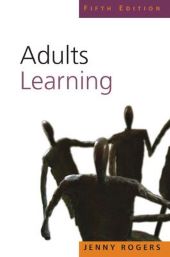
Adults Learning, 5th Edition
How do adults really learn?
How do I handle the first class or session?
How can I get my material across in a way that will interest and excite people?
Completely revised and updated throughout, the new edition of this friendly and practical book is the guide on how to teach adults. Written in an accessible style, it unravels the myths of teaching adults, while explaining why it is both a rewarding and a complex task.
Using case studies and examples from a wide range of sources including higher education, adult education and management development, Adults Learning answers questions such as:
- How do I deal with a group of mixed ability?
- How can I can I manage the conflicts that may arise in a group?
- Which teaching methods work best and which are least effective?
The author includes new chapters on problem-based learning and action learning, updated and extensive new material on handling groups, and a revised chapter on coaching, providing plenty of points for further discussion.
Adults Learning is a must-read for anyone involved in teaching adults.
Praise for the series
View our webinar: Talking with Dementia, Reconsidered: A Journey of Collaboration and Innovation in Dementia Care
Discover:
- Behind-the-scenes insights: Learn about the collaborative process that led to the creation of this landmark resource in the field of Dementia context of the Reconsidering Dementia Series.
- Expert perspectives: Hear from Dr. Keith Oliver, a leading advocate for dementia living with the condition, and Reinhard Gus, a renowned clinical psychologist.
- Firsthand accounts: Gain insights from individuals living with dementia.
- Best practices: Discover practical strategies for improving dementia care.
- This webinar offers a unique opportunity to learn from experts and gain a deeper understanding of dementia care.
Interested in using these titles?
If you are interested in using these titles on your course, contact our Marketing team at: