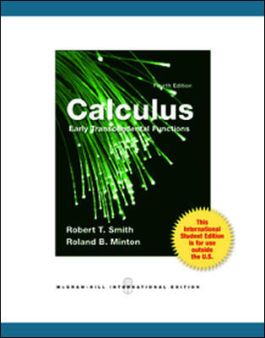
EBOOK: Calculus: Early Transcendental Functions

EBOOK: Calculus: Early Transcendental Functions
4th edition

More Views

You will need the free Vital Source Bookshelf on your device in order to complete registration and access this e-book. Go to http://bookshelf.vitalsource.com/ login or create an account and enter the code you have been given to access your book.

£48.99

£44.09

Free Delivery

Description

Details


Students who have used Smith/Minton's Calculus say it was easier to read than any other math book they've used. That testimony underscores the success of the authors’ approach, which combines the best elements of reform with the most reliable aspects of mainstream calculus teaching, resulting in a motivating, challenging book. Smith/Minton also provide exceptional, reality-based applications that appeal to students’ interests and demonstrate the elegance of math in the world around us.

New features include:
• A new organization placing all transcendental functions early in the book and consolidating the introduction to L'Hôpital's Rule in a single section.
• More concisely written explanations in every chapter.
• Many new exercises (for a total of 7,000 throughout the book) that require additional rigor not found in the 2nd Edition.
• New exploratory exercises in every section that challenge students to synthesize key concepts to solve intriguing projects.
• New commentaries (“Beyond Formulas”) that encourage students to think mathematically beyond the procedures they learn.
• New counterpoints to the historical notes, “Today in Mathematics,” that stress the contemporary dynamism of mathematical research and applications, connecting past contributions to the present.
• An enhanced discussion of differential equations and additional applications of vector calculus.

Content

Contents


Chapter 0: Preliminaries 0.1 Polynomials and Rational Functions 0.2 Graphing Calculators and Computer Algebra Systems 0.3 Inverse Functions 0.4 Trigonometric and Inverse Trigonometric Functions 0.5 Exponential and Logarithmic Functions 0.6 Transformations of Functions Chapter 1: Limits and Continuity 1.1 A Brief Preview of Calculus: Tangent Lines and the Length of a Curve 1.2 The Concept of Limit 1.3 Computation of Limits 1.4 Continuity and Its Consequences 1.5 Limits Involving Infinity; Asymptotes 1.6 Formal Definition of the Limit 1.7 Limits and Loss-of-Significance Errors Chapter 2: Differentiation 2.1 Tangent Lines and Velocity 2.2 The Derivative 2.3 Computation of Derivatives: The Power Rule 2.4 The Product and Quotient Rules 2.5 The Chain Rule 2.6 Derivatives of Trigonometric Functions 2.7 Derivatives of Exponential and Logarithmic Functions 2.8 Implicit Differentiation and Inverse Trigonometric Functions 2.9 The Hyperbolic Functions 2.10 The Mean Value Theorem Chapter 3: Applications of the Derivative 3.1 Linear Approximations and Newton's Method 3.2 Indeterminate Forms and L'Hôpital's Rule 3.3 Maximum and Minimum Values 3.4 Increasing and Decreasing Functions 3.5 Concavity and the Second Derivative Test 3.6 Overview of Curve Sketching 3.7 Optimization 3.8 Related Rates 3.9 Rates of Change in Economics and the Sciences Chapter 4: Integration 4.1 Antiderivatives 4.2 Sums and Sigma Notation 4.3 Area 4.4 The Definite Integral 4.5 The Fundamental Theorem of Calculus 4.6 Integration by Substitution 4.7 Numerical Integration 4.8 The Natural Logarithm as an Integral Chapter 5: Applications of the Definite Integral 5.1 Area Between Curves 5.2 Volume: Slicing, Disks and Washers 5.3 Volumes by Cylindrical Shells 5.4 Arc Length and Surface Area 5.5 Projectile Motion 5.6 Applications of Integration to Physics and Engineering 5.7 Probability Chapter 6: Integration Techniques 6.1 Review of Formulas and Techniques 6.2 Integration by Parts 6.3 Trigonometric Techniques of Integration 6.4 Integration of Rational Functions Using Partial Fractions 6.5 Integration Tables and Computer Algebra Systems 6.6 Improper Integrals Chapter 7: First-Order Differential Equations 7.1 Modeling with Differential Equations 7.2 Separable Differential Equations 7.3 Direction Fields and Euler's Method 7.4 Systems of First-Order Differential Equations Chapter 8: Infinite Series 8.1 Sequences of Real Numbers 8.2 Infinite Series 8.3 The Integral and Comparison Tests 8.4 Alternating Series 8.5 Absolute Convergence and the Ratio Test 8.6 Power Series 8.7 Taylor Series 8.8 Applications of Taylor Series 8.9 Fourier Series Chapter 9: Parametric Equations and Polar Coordinates 9.1 Plane Curves and Parametric Equations 9.2 Calculus and Parametric Equations 9.3 Arc Length and Surface Area in Parametric Equations 9.4 Polar Coordinates 9.5 Calculus and Polar Coordinates 9.6 Conic Sections 9.7 Conic Sections in Polar Coordinates Chapter 10: Vectors and the Geometry of Space 10.1 Vectors in the Plane 10.2 Vectors in Space 10.3 The Dot Product 10.4 The Cross Product 10.5 Lines and Planes in Space 10.6 Surfaces in Space Chapter 11: Vector-Valued Functions 11.1 Vector-Valued Functions 11.2 The Calculus of Vector-Valued Functions 11.3 Motion in Space 11.4 Curvature 11.5 Tangent and Normal Vectors 11.6 Parametric Surfaces Chapter 12: Functions of Several Variables and Partial Differentiation 12.1 Functions of Several Variables 12.2 Limits and Continuity 12.3 Partial Derivatives 12.4 Tangent Planes and Linear Approximations 12.5 The Chain Rule 12.6 The Gradient and Directional Derivatives 12.7 Extrema of Functions of Several Variables 12.8 Constrained Optimization and and Lagrange Multipliers Chapter 13: Multiple Integrals 13.1 Double Integrals 13.2 Area, Volume and Center of Mass 13.3 Double Integrals in Polar Coordinates 13.4 Surface Area 13.5 Triple Integrals 13.6 Cylindrical Coordinates 13.7 Spherical Coordinates 13.8 Change of Variables in Multiple Integrals Chapter 14: Vector Calculus 14.1 Vector Fields 14.2 Line Integrals 14.3 Independence of Path and Conservative Vector Fields 14.4 Green's Theorem 14.5 Curl and Divergence 14.6 Surface Integrals 14.7 The Divergence Theorem 14.8 Stokes' Theorem 14.9 Applications of Vector Calculus Chapter 15: Second Order Differential Equations 15.1 Second-Order Equations With Constant Coefficients 15.2 Nonhomogeneous Equations: Undetermined Coefficients 15.3 Applications of Second-Order Equations 15.4 Power Series Solutions of Differential Equations
Appendix A: Proofs of Selected Theorems Appendix B: Answers to Odd-Numbered Exercises
Reviews

Be the first to review this product

Write Your Own Review

You're reviewing: EBOOK: Calculus: Early Transcendental Functions

Details

Additional Information

ISBN (10-digit) 0077144376
ISBN 9780077144371
Authors Robert T Smith, Roland B Minton
Edition 4
Series UK Higher Education Mathematics Mathematics
Previous Edition's ISBN N/A
Binding Undefined
Published 1 Feb 2011
Stock Due N/A
Market N/A
Division GB
Review Copy Available No
Keywords N/A
Format VitalSource e-Book
Availability Type None
Blink Division N/A
Request a Review Copy

Submit