
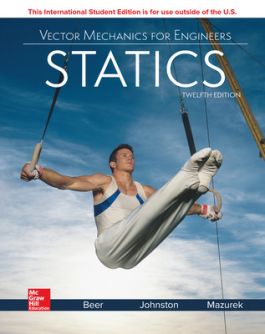
ISE Vector Mechanics for Engineers: Statics
Receive via shipping:
- Colour, print bound version of the complete text
1) Introduction
2) Statics of Particles3) Rigid Bodies: Equivalent Systems of Forces4) Equilibrium of Rigid Bodies5) Distributed Forces: Centroids and Centers of Gravity6) Analysis of Structures7) Internal Forces and Moments8) Friction9) Distributed Forces: Moments of Inertia10) Method of Virtual WorkFundamentals of Engineering ExaminationIndex Answers to ProblemsThe 12th edition has new case studies and enhancements in the text and in Connect. The hallmark of the Beer-Johnston series has been the problem sets.This edition is no different. Over 650 of the homework problems in the text are new or revised. One of the characteristics of the approach used in this book is that mechanics of particles is clearly separated from the mechanics of rigid bodies. This approach makes it possible to consider simple practical applications at an early stage and to postpone the introduction of the more difficult concepts. Additionally, Connect has over 100 Free-Body Diagram Tool Problems and Process-Oriented Problems.
McGraw-Hill's Connect, is also available. Connect is the only integrated learning system that empowers students by continuously adapting to deliver precisely what they need, when they need it, how they need it, so that class time is more effective. Connect allows the professor to assign homework, quizzes, and tests easily and automatically grades and records the scores of the student's work. Problems are randomized to prevent sharing of answers an may also have a "multi-step solution" which helps move the students' learning along if they experience difficulty.

McGraw Hill Connect is an award-winning digital teaching and learning solution that empowers students to achieve better outcomes and enables instructors to improve course management efficiency.
High-Quality Course Material
Our trusted solutions are designed to help students actively engage in course content and develop critical higher-level thinking skills while offering you the flexibility to tailor your course to the ways you teach and the ways your students learn.
Assignments & Automatic Grading
Connect features a question bank that you can select from to create homework, practice tests and quizzes. Dramatically reduce the amount of time you spend reviewing homework and grading quizzes, freeing up your valuable time to spend on teaching.
Analytics & Reporting
Monitor progress and improve focus with Connect’s visual and actionable dashboards. Reports are available to empower both instructors and students with real-time performance analytics.
Seamless Integration
Link your Learning Management with Connect for single sign-on and gradebook synchronization, with all-in-one ease for you and your students.